


Phong Nha – Ke Bang National Park
The boat slows, and the air turns cool and mineral, like standing near a fridge left open. That’s the cave breathing before you even see it.
The road into Phong Nha grows quieter with every kilometre. Rice fields give way to limestone hills, the mountains rise a little higher, and the landscape begins to feel wilder, less settled. It rarely feels dramatic in an obvious way. The rivers move slowly here, water buffalo graze beside village roads, and the mountains sit heavily on the horizon, covered in dense forest.
Underneath all of it more caves than anyone has fully counted. Over three hundred, some mapped only in the last thirty years, some not at all.
The boat into Phong Nha Cave glides past rice fields and water buffalo before the mountain swallows you whole. Inside, it’s dark except where the guide’s light lands on stalactites hanging like something half-melted, on water so still it doubles the ceiling. The sound of the river echoes beneath the stone, and your voice sounds different in there. Flatter, closer.
Paradise Cave is drier, walkable. Wooden paths lead a kilometer in, past columns thick as tree trunks, some still forming, drop by slow drop. It smells of stone and standing water, and somewhere past the lit path, it just keeps going thirty-one kilometers of dark most visitors never see.
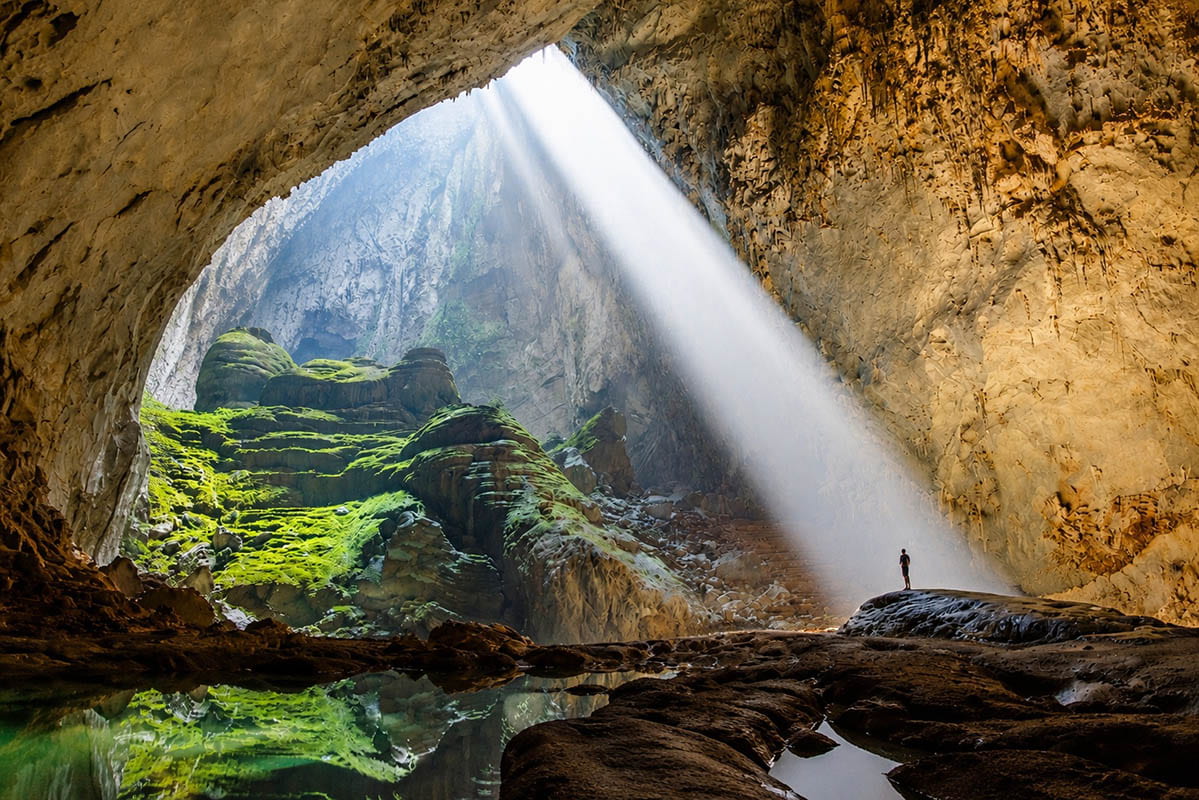
For those willing to sweat for it, the trek to Hang En takes a full day through jungle and river crossings. You sleep on a sand beach inside the cave, the ceiling so high your torchlight doesn’t reach it. Somewhere beyond that is Son Doong, the largest cave in the world its own weather, its own clouds, forming underground.
Not everyone wants that much cave. Some days call for a kayak instead, or a bike ride past peanut fields and small villages, jungle trails disappearing into valleys where butterflies outnumber people and birdsong carries through the trees.
At sunset, the limestone peaks turn soft and blue, and smoke begins to rise from kitchen fires along the riverbanks. The day trippers leave, the pace slows further, and the whole place feels suspended between forest and stone.
Phong Nha can be visited in a couple of days, but it has a habit of making people stay longer than planned.
Best time to go: February–August offers the best weather for exploring the caves and countryside (July–August can run hot). September–November brings heavy rain and occasional flooding best avoided.
From Hanoi: about 1 hour by flight to Dong Hoi, then a 45-minute drive to Phong Nha village. Overnight trains from Hanoi are also available.
Good to know: book cave treks (Hang En, Son Doong) well in advance permits are limited and most cave visits need a licensed guide. Bring comfortable walking shoes and a light jacket; even on hot days, the caves feel surprisingly cool.
Planning a trip to Phong Nha, or anywhere else in Vietnam? Our travelers have shared their own experiences on TripAdvisor — take a look, or get in touch and we’ll help you plan the trip yourself.
Speak to one of our local experts

Our itineraries offer inspiration for exploring Phong Nha Ke Bang National Park, while every journey we create is carefully tailored to your interests, passions and style of travel.
Bai Tu Long Bay ⟩ Con Dao
Bai Tu Long Bay ⟩ Ha Long Bay
Bai Tu Long Bay ⟩ Da Nang
Bai Tu Long Bay ⟩ Hue
Bai Tu Long Bay ⟩ Hoi An
Bai Tu Long Bay ⟩ Hanoi
Bai Tu Long Bay ⟩ Mui Ne & Phan Thiet
Bai Tu Long Bay ⟩ Phu Quoc Island
Bai Tu Long Bay ⟩ Quy Nhon
Bai Tu Long Bay ⟩ Mekong Delta
Bai Tu Long Bay ⟩ Ninh Binh
Bai Tu Long Bay ⟩ Sapa
Vietnam Travel Inspiration
Our specialists travel regularly throughout Vietnam, uncovering new experiences and sharing their latest recommendations on the best places to stay, dine and explore.